
As drone technology gains attention for its potential to improve precision, accessibility to fields, and sustainability in agriculture, its use remains highly restricted under current regulations. Against this backdrop, SynTech Research is leveraging its expertise in field trials and regulatory support to validate drone-assisted biological control solutions, helping innovators demonstrate compliance and efficacy across Europe.
Navigating the EU Regulatory Landscape
Under the Directive 2009/128/EC Of The European Parliament And Of The Council (SUD), aerial spraying – including by drones – is generally restricted. However, Article 9 of the directive allows Member States to grant exemptions when strict conditions are met. This flexibility has opened the door for innovation, and several countries, including Germany, France, and Hungary, have begun to define frameworks for drone spraying in targeted scenarios. Hungary, for instance, is one of the first EU countries to create a structured pathway for legal drone spraying. It has done so by introducing national guidelines that define conditions for drone spraying, making it possible to conduct studies that meet regulatory requirements for registration.
Hungary at the Regulatory Forefront
Hungary’s framework, the National Food Chain Safety Office (Nébih)’s Decree 44/2005 (V.6) on aerial plant protection and its subsequent updates, enables drone application of plant protection products through use extensions for approved pesticides. Authorization is contingent on three critical factors:
- Demonstrating clear advantages over land-based methods.
- Ensuring the product is approved for aerial use.
- Verifying that the operator holds certified qualifications.
The Hungarian guideline introduces several innovations:
- Efficacy Trial Standards tailored to drone technology.
- Spray-Drift Evaluation Protocols to support environmental exposure assessments.
- Equipment Requirements, mandating commercially approved drones equipped with certified nozzle types consistent with type-approval specifications.
This approach not only addresses safety and environmental concerns but also creates a predictable pathway for technology adoption.
OECD Engagement and Global Harmonization
Recognizing the transformative potential of drones in agriculture, the OECD has defined expectations and standards for risk assessment in “Guiding principles, processes, and criteria for the work of the OECD Drone/UASS Subgroup of the Working Party on Pesticides”. A dedicated international task force is now developing advanced models to evaluate human health and environmental safety. These efforts aim to harmonize standards globally, reducing regulatory fragmentation and accelerating innovation.
SynTech’s Role: From Research to Registration
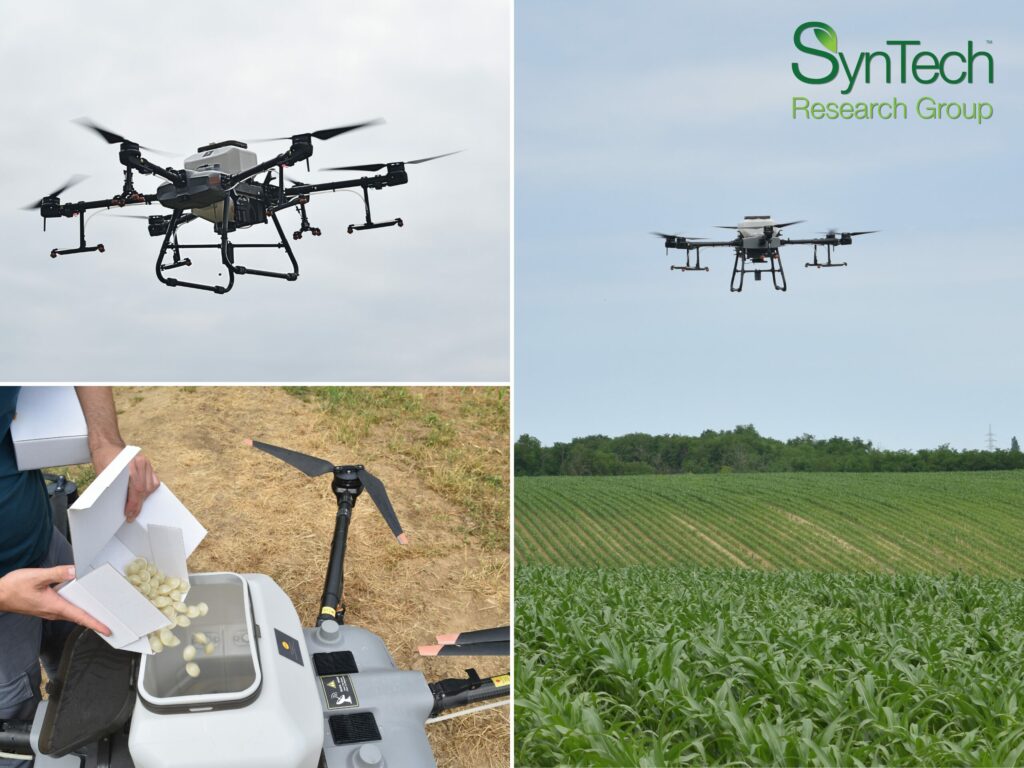
As regulatory frameworks evolve, SynTech Research is actively supporting innovation through rigorous field trials and compliance expertise. A recent case study illustrates this commitment: drone-based application of macrobial pesticides in maize.
The trial focused on four commercial Trichogramma-based biological control products, applied using drones equipped with precision release systems. Each product was encapsulated in rain-resistant biodegradable capsules and deployed according to a structured program targeting the European corn borer (Ostrinia nubilalis) and later the cotton bollworm (Helicoverpa armigera).
Key features of the trial:
- Conducted on large-scale, organically managed maize plots using a randomized block design.
- Applications timed to coincide with pest life cycles, guided by weather forecasts and swarming dynamics.
- Performance metrics included larval infestation levels, crop damage, and yield, assessed according to official methodologies.
The trial provided valuable insights, confirming operational feasibility of drone-assisted biological control, alignment with Hungary’s regulatory requirements, and highlighted the potential role of drones in advancing sustainable pest management strategies in European agriculture.
Looking ahead
Drone-based application of biocontrol products represents a step toward precision agriculture and reduced environmental impact. Nonetheless, widespread adoption across Europe will require continued collaboration between innovators, regulators and research partners. SynTech Research Group remains committed to accompanying this innovation journey, from research to registration, helping ag-tech companies and growers unlock the full potential of drone technology.