
SynTech France in intensive period of soil micro arthropod assessments

[et_pb_section fb_built=”1″ admin_label=”section” _builder_version=”3.22″ global_colors_info=”{}”][et_pb_row column_structure=”1_2,1_2″ admin_label=”row” _builder_version=”3.25″ background_size=”initial” background_position=”top_left” background_repeat=”repeat” global_colors_info=”{}”][et_pb_column type=”1_2″ _builder_version=”3.25″ custom_padding=”|||” global_colors_info=”{}” custom_padding__hover=”|||”][et_pb_text _builder_version=”4.10.8″ _module_preset=”default” global_colors_info=”{}”]

Our ecotoxicology teams in France are now in full swing extracting microarthropods from soil microfauna field studies. Trials were started in early Spring and we are now engaged in the 6-month assessments.

Soil-dwelling mites, collembola and other soil microarthropods play an important role in litter decomposition. In-crop and off-crop field studies on natural populations evaluate the effects of plant protection products on these non-target arthropods.

Soil core samples are made at 1, 3, 6 and 12 months after application. Microarthropods are extracted from the soil in Berlese (Tulgren) funnel apparatus. This involves a desiccation gradient; mobile organisms move from the dry environment and fall into collecting vessels for counting and species identification. Soil microarthropod field studies are usually combined with earthworm field studies.

This it is the right time to book study slots for soil organism testing or any other higher tier testing needs in Spring 2022; contact eythier@syntechresearch.com for more information on:

  • Honey bee brood semi-field and field studies (treated crop or feeding exposure)
  • Solitary bee and bumble bee semi-field and field studies
  • Pollinator residues studies (pollen, nectar, honey and other bee matrices)
  • NTA aged residue and semi-field studies – NTA in-crop and off-crop field studies
  • Predatory mite field studies
  • Residue studies in arthropods
  • Earthworm field studies
  • Soil microfauna field studies
  • Residue studies in soil organisms
  • Monitoring studies on pollinators, arthropods and soil organisms

[/et_pb_text][/et_pb_column][et_pb_column type=”1_2″ _builder_version=”3.25″ custom_padding=”|||” global_colors_info=”{}” custom_padding__hover=”|||”][et_pb_blurb _builder_version=”4.10.8″ _module_preset=”default” global_colors_info=”{}”]
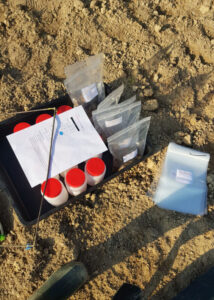
Collection of soil samples in the field
[/et_pb_blurb][et_pb_blurb _builder_version=”4.10.8″ _module_preset=”default” global_colors_info=”{}”]
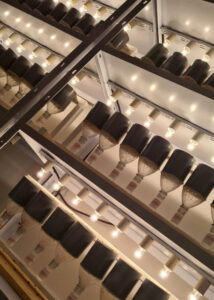
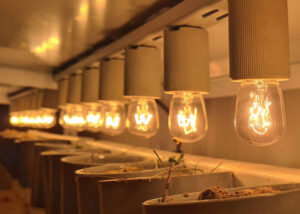
Collection of microarthropods from soil samples using Berlese extraction method
[/et_pb_blurb][et_pb_blurb _builder_version=”4.10.8″ _module_preset=”default” global_colors_info=”{}”]
Berlese funnel units
[/et_pb_blurb][/et_pb_column][/et_pb_row][et_pb_row column_structure=”1_3,1_3,1_3″ _builder_version=”4.10.8″ _module_preset=”default” global_colors_info=”{}”][et_pb_column type=”1_3″ _builder_version=”4.10.8″ _module_preset=”default” global_colors_info=”{}”][et_pb_blurb _builder_version=”4.10.8″ _module_preset=”default” global_colors_info=”{}”]
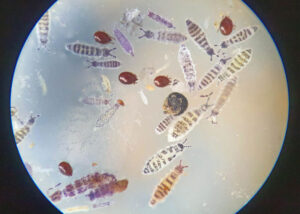
Collembolan and Oribatida mites collected from one soil sample
[/et_pb_blurb][/et_pb_column][et_pb_column type=”1_3″ _builder_version=”4.10.8″ _module_preset=”default” global_colors_info=”{}”][et_pb_blurb _builder_version=”4.10.8″ _module_preset=”default” global_colors_info=”{}”]
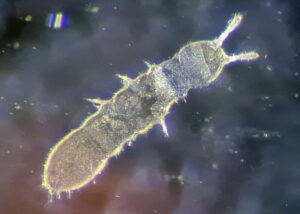
Collembolan (Folsomia quadrioculata (Tullberg, 1871)) mounted in lactophenol on microscope slide for identification
[/et_pb_blurb][/et_pb_column][et_pb_column type=”1_3″ _builder_version=”4.10.8″ _module_preset=”default” global_colors_info=”{}”][et_pb_blurb _builder_version=”4.10.8″ _module_preset=”default” global_colors_info=”{}”]
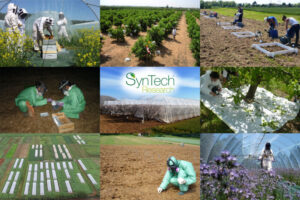
Pollinator, NTA and soil higher tier studies performed at SynTech
[/et_pb_blurb][/et_pb_column][/et_pb_row][/et_pb_section]

Other related posts

Nematodes: Pests or Protectors? Understanding their dual role in Crop Health

Nematodes are among the most influential organisms in agriculture: both as destructive pests and as valuable allies. Their dual role makes them critical to understand for anyone committed to sustainable crop production. The Two Faces... read more

SynTech Research Group Highlights Advances in Plant Breeding Amid New EU Regulation

SynTech Research Group is emphasizing its capabilities in modern plant breeding as Europe moves forward with significant regulatory changes concerning New Genomic Techniques (NGTs). The European Commission recently introduced a regulation that could redefine the... read more

SynTech Research Group Celebrates 26 Years of Excellence

Founded in California in 1999, SynTech Research proudly marks its 26th anniversary as a leading agricultural Contract Research Organization (CRO). Over the years, the Group has strengthened its expertise and global reach, building on a... read more

Banana Crop Health: How SynTech Research Is Combating Global Banana Diseases

Global Trials in South America, Asia, and Africa that are redefining Crop Protection Bananas are not just a household favorite, they are a global economic powerhouse. In fact, preliminary estimates from the FAO show that... read more

SynTech Research in Spain Expands GLP-Certified Capabilities with Physico-Chemical Testing

SynTech Research Group is pleased to announce the expansion of its Good Laboratory Practice (GLP) certification by Entidad Nacional de Acreditación (ENAC) at its Picanya facility in Spain, now officially including physico-chemical testing of phytosanitary... read more

A Guide to State Registration Renewal Deadlines for AgChem and Biopesticide Products

December marks a critical juncture: the window for annual state product registration renewals is nearing, and missing deadlines can lead to steep penalties or compliance gaps. At SynTech Research Group, we specialize in helping companies... read more